
Sustainability is on everyone's lips, and it is important. It's about us and our future, about a healthy environment, healthy people, a fair and just world for everyone. Come along and discover good examples in Thuringia – certified spots, sustainabel offers, national natural landscapes and more!
A cube with a sky ladder
Discovery tour Bauhaus Museum Weimar
Taste is a question of course... The New Bauhaus Museum Weimar, which opened in 2019, has sparked controversy. The Klassik Stiftung Weimar collaborated with architect Heike Hanada to complete the modern structure in time for the 100th Bauhaus celebration in Weimar. Since then, the world's oldest Bauhaus collection, still created by Walter Gropius himself, has called this place home.
It is one of Germany's most modern new museums, with about 268,000 visitors in 2019 (in just 9 months), making it the most frequented museum in Weimar. And it stands out for its unique architecture, which moves not only the inhabitants of Weimar, but also the media and visitors from all over the world. However, when you stand in front of it, you think it's simple and square. But was it truly a fact?
Form follows function
The New Bauhaus Museum Weimar is a magnificent cube that blends in nicely with the new "Quartier der Moderne" in the area between Weimar's city center and the railway station. The building is almost completely devoid of windows and doors, but it must remain functional. A museum building places unique demands on architecture, but this gorgeous grey concrete cube is growing lighter. At night, when filigree LED strips glow brightly on the outer wall. During the day, as soon as you go through the huge glass gateway, the foyer is light and spacious. The view widens up into overlapping double floors and straight ahead - to a modern greeting space where visitors can rapidly orient themselves and stretch out, even with enormous monitors. Even a wide light portion in the back surprises with its perspective of the green.
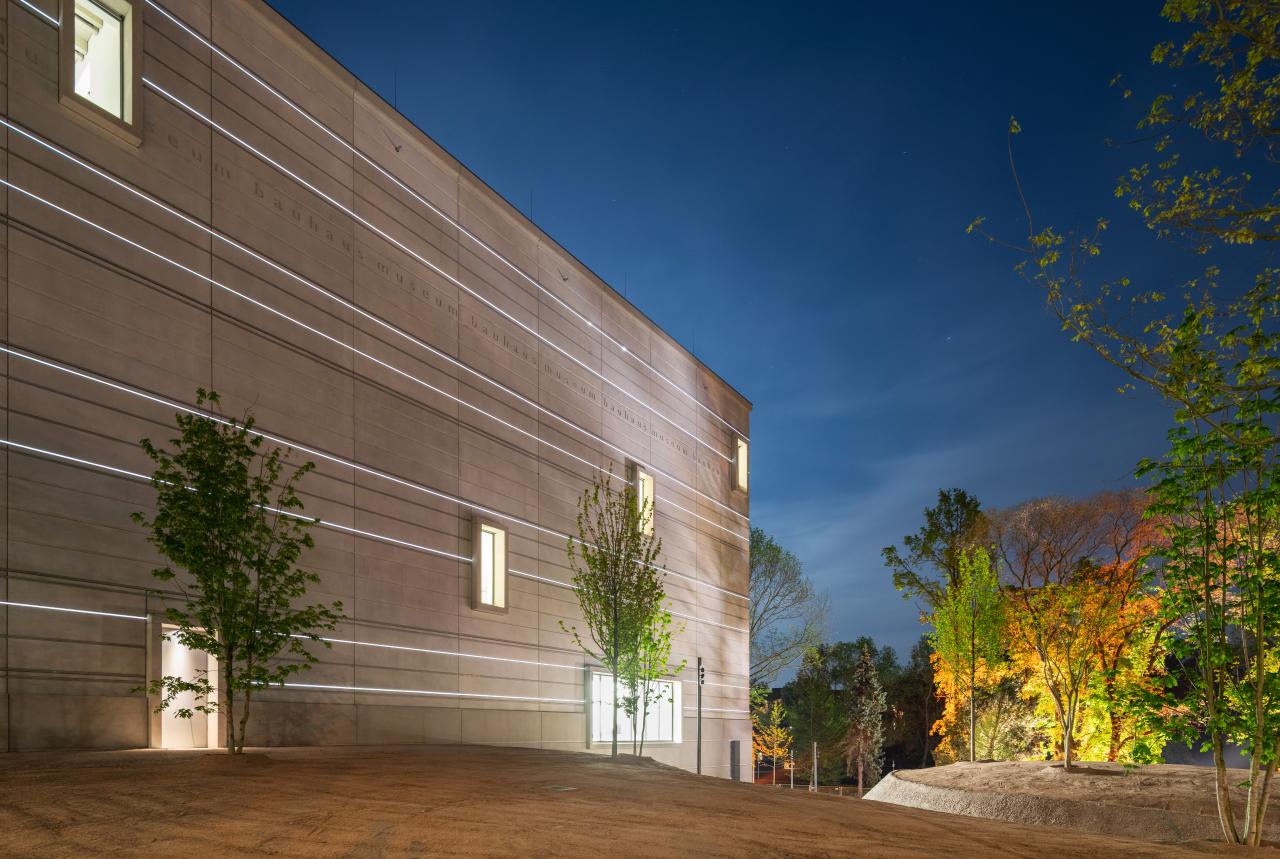
Bauhaus-Museum Weimar in the evening ©Thomas Müller, Klassik Stiftung Weimar
World-class exhibits
The Weimar+ app guides visitors through the building and the many exhibitions on three floors, and it can be downloaded quickly and easily to any mobile phone. It also includes a graphic guided tour for people with visual impairments. On a total of 2,250 m2, Gropius' question "How do we want to live together?" should be addressed. Each visitor explores the show independently. Outstanding exhibitions include Mies van de Rohe's elegant Barcelona Chair and the colorful Keler cradle. The Klassik Stiftung Weimar's Bauhaus collection now numbers approximately 13,000 exhibits. From the Wagenfeld lamp to Breuer's wooden slatted chair and Kandinsky's paintings, the link to modern life is always expressed in an astonishing, multi-medial, and humorous abstract manner.

Peter Keler, Children's cradle (1922) at the Bauhaus-Museum Weimar ©Alexander Burzik, Klassik Stiftung Weimar
Immerse yourself: On the go with the Weimar+ app
The airy views between the floors and particular spaces reinforce the aim of conveying the Bauhaus tale thematically rather than chronologically. So, the visitor travels from island to island, holding the cellphone guide to his ear. You can freely immerse and learn, beginning with the "experiment" through “the new man", "stage" and "new everyday life" to the region "Was bleibt" (What lasts)? The upper floor provides a modern forum for the Bauhaus' three directors, Gropius, Mies, and Meyer. Multimedia stations on all floors showcase the Bauhaus' startling diversity and invite you to sensual sensations. Running text, quotations, and take-away posters encourage contemplation and discussion about the current.

Ship building game by Alma Siedhoff-Buscher at the Bauhaus Museum Weimar ©Candy Welz, Klassik Stiftung Weimar
Like in another universe
The guest leaves many impressions. Sometimes cool and abstract, sometimes human and emotional - that is what you see up close here in this museum. As in a massive, time-spanning Bauhaus project. You float between the past and the present, and you are constantly learning new things. Some people like some, others don’t. You'd want to dance on this large virtual stage; simply press down the lovely doorknobs one after the other, or trace the churches in Feininger's paintings with canvas and brush... Tip: On the second level, there is an exhibition part where you can see and try out the many chairs (replicas) designed by Breuer and co.

Café Kunstpause (Art break) ©Stephan Consemüller, Klassik Stiftung Weimar/Bauhaus-Museum Weimar, permanent loan, private property, Berlin, Courtesy of Wulf Herzogenrath, CLAUS BACH ® PHOTOGRAPHY
The visitor glides down the spectacular "Himmelsleiter" at the end of the interesting display realms to reach the bottom floor. You slip the handy guide back into your pocket and emerge from your own small Bauhaus universe of ideas. Like a bird landing softly and safely in a verdant meadow after a long flight. And if you then sit in the small café art break, strengthen yourself with a cup of coffee and a piece of cake, and look at the human rubbing in the Weimarhallen-Park or listen to the steaming conversation at the next table, you will have returned to the pulsating, realistic presence of your own life.
⠇
An experience for everyone
People with visual impairments can experience the exhibition at the Bauhaus Museum through tactile models and SitOns, historical furniture for trial possession, registered guided tours, or the Klassik Stiftung Weimar app, which includes an audio guide. The mansion may also be toured using the app, which offers accessible tours in simple or child-friendly English. People with walking difficulties or in wheelchairs can see the entire show on their own. A wheelchair or rollator can be borrowed at reception, and every floor is accessible by elevator. The museum is dedicated to the philosophy of design for all, allowing all visitors to experience the modernity that surrounds the Bauhaus.
Head picture: ©Dominik Saure, Thüringer Tourismus GmbH
Accessibility information
Anfahrt

Special barrier-free offers in Thuringia
The Toskana Therme and the Hotel an der Therme in Bad Sulza - in the middle of the gently rolling hills of the Tuscany of the East - offer everything you need for a holiday and relaxation.
(Photo: Stefan Hopf / Toskana World GmbH)


