


Sustainability is on everyone's lips, and it is important. It's about us and our future, about a healthy environment, healthy people, a fair and just world for everyone. Come along and discover good examples in Thuringia – certified spots, sustainabel offers, national natural landscapes and more!
Rose City Bad Langensalza
In full blossom
Bad Langensalza is a town with eleven distinct parks and themed gardens, as well as palm and olive trees in the streets.
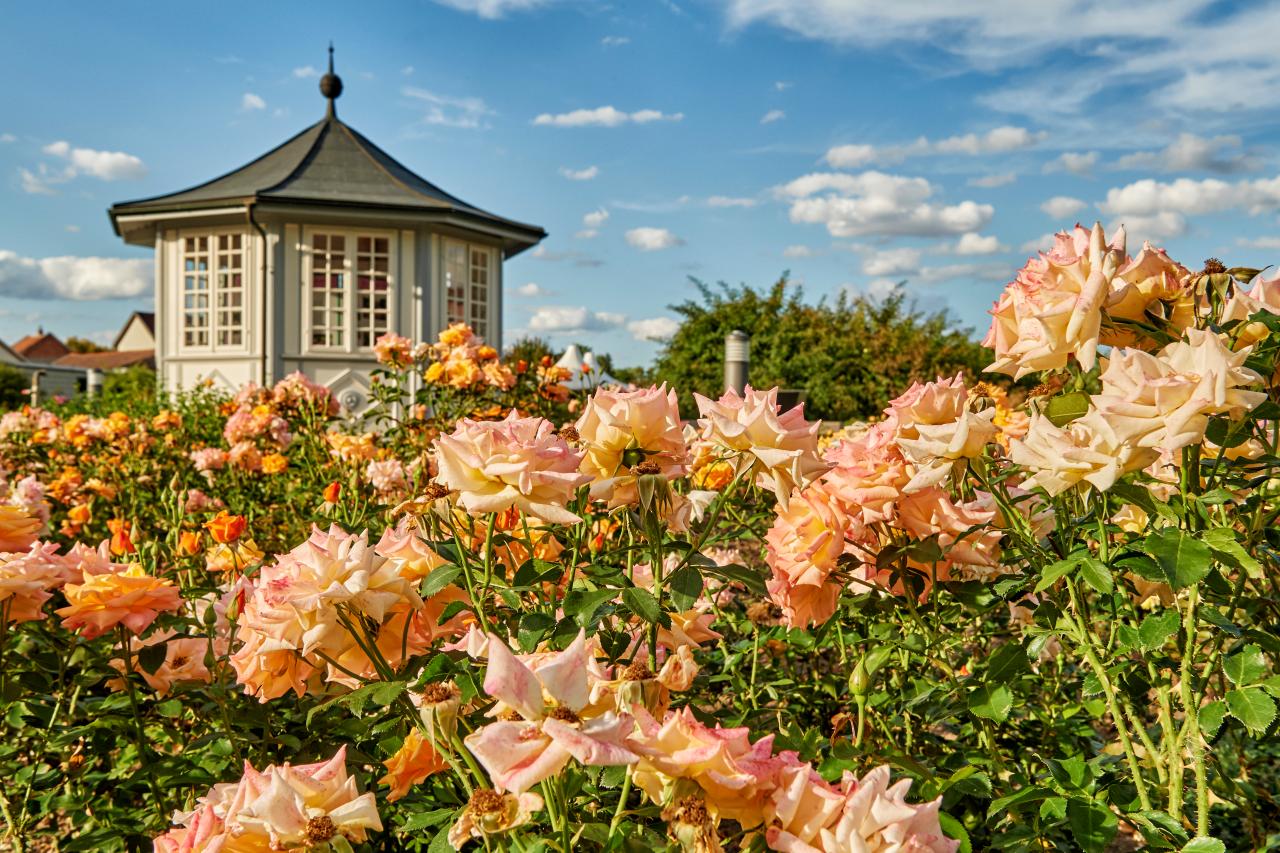
The aroma of the "Cherry Brandy" rose variety remains in the air, but the following delicate cloud has already passed over. "Grand Amore" is Ingo Günther's favorite rose, according to the sign. He oversees horticulture in Bad Langensalza, the town that serves as the gateway to the UNESCO World Heritage Site Hainich National Park. "Good style, large flowers, strong growth," is how he defines his favourite. We go together through the town's rose garden, past fields of color-sorted roses with perfume labels that mimic wine descriptions. "Blackberry nuance," "apple and cinnamon note," and "vanilla and pepper." However, you don't simply need a clear nose to enter the sensual domain of the queen of flowers. You'll also need time because about 450 different rose kinds bloom on the 18,000 square meters, including noble and shrub roses named Red Dragon, Leonardo da Vinci, and Black Madonna. This is thanks to Walter Berger, a rose breeder and master gardener, and, most importantly, to his wife Anni Berger, who carried on his passion. Her first variety, "Bergers Barbarina," hit the market in 1965. Many more followed: Anni Berger introduced 50 rose types to the market. A bust in the center of the park-like area honors Germany's successful rose breeder.
⠇
From Rose Flash to Zen Meditation
When it comes to garden culture, this town is difficult to beat. Bad Langensalza has eleven separate parks and themed gardens. The next one is directly opposite: the Japanese Garden. "Garden of Bliss" is written on a sign near the entrance. Simply hearing these words makes me happy. We carefully enter the grounds, followed by quiet. Only the rustling of leaves in the wind and the splashing of waterfalls are audible. Place of sacred trees, cherry orchard, bamboo and azalea garden, maple and tea garden - all themed sections flow seamlessly into one another. "Above all, the key term is deceleration. "You should be able to relax and focus on the essentials," says Ingo Günther, pointing to the tea house. "Over there is the only bonsai sequoia forest in Europe." We go over to admire the amazing bonsai specimen and then explore the interior of the pagoda-like structure. The soothing Asian sounds caress our ears.
Banana plants, bamboo, and ferns extend their leafy faces toward the sky, which shines through the glass roof structure. It must be an unforgettable experience to participate in a Japanese tea ceremony in this setting, which is held several times a year. Thoughts are still racing through my mind as I come across a framed remark by Sen no Rikyu, a Buddhist monk and master of the Japanese tea ceremony: "As the garden path is nothing more than a path away from the worldly way of life, it will probably free the heart from its impurity.” I believe that is correct. Walking in nature and gardens allows us to unwind and rejuvenate our hearts and minds. From the teahouse, we cross a wooden bridge that leads to a landscape of ponds filled with koi, water lilies, and water lilies. We slowly leave the Japanese Garden and head towards Schlösschenpark.
⠇

A stream as air conditioning
Throughout our tour, I observe a moat that is always present. "The course of the stream mirrors the course of the former mill race," Günther tells me. "It's like a natural air conditioning system, cools on hot summer days and provides a habitat for pretty aquatic plants." Arriving to the terraced, baroque Schlösschenpark, we discuss the town's spa heritage, which now has over 200 years of history: sulphurous springs were found in 1811. Langensalza is now a state-approved spa that provides natural cures such as sulphur water, thermal brine, and therapeutic drinking water. And the "most blooming town in Europe," according to a competition held a few years ago. As far as the eye can see, everything is lush and green. There are lush potted plants everywhere in the city, including palm trees, olive trees, rambleros, and laurel bushes. "Guests and residents should enjoy a Mediterranean lifestyle," states Ingo Günther. "And the people of Langensalza can hardly wait until we open the doors to our wintering halls in mid-April and the plants return to their summer locations." According to Günther, something has changed since the city planted the plants: "People walk more leisurely, are more relaxed, and take time for a chat over a coffee." And so, we continue our leisurely stroll through Bad Langensalza's green oases: to the pharmacist's garden with its medicinal herb beds and the pharmacist's museum, to the nature garden with its dyer's plants, wild shrubs, and natural pond, and, of course, to the arboretum tree garden with its over 200 different tree and plant species. A wonderful delight!
⠇

⠇
An experience for everyone
The city and its themed gardens also encourage visitors with reduced mobility to stroll and linger. The Friederikentherme, which is accessible from ground level, provides additional relaxation. Guests with visual impairments or blindness can learn about the intriguing history of Bad Langensalza, the Rose Garden, and the Japanese Garden using the app "You see more when you hear". It gives the user skilled eyes and accurate picture descriptions.
Discover more ...

Special barrier-free offers in Thuringia
The Toskana Therme and the Hotel an der Therme in Bad Sulza - in the middle of the gently rolling hills of the Tuscany of the East - offer everything you need for a holiday and relaxation.
(Photo: Stefan Hopf / Toskana World GmbH)


